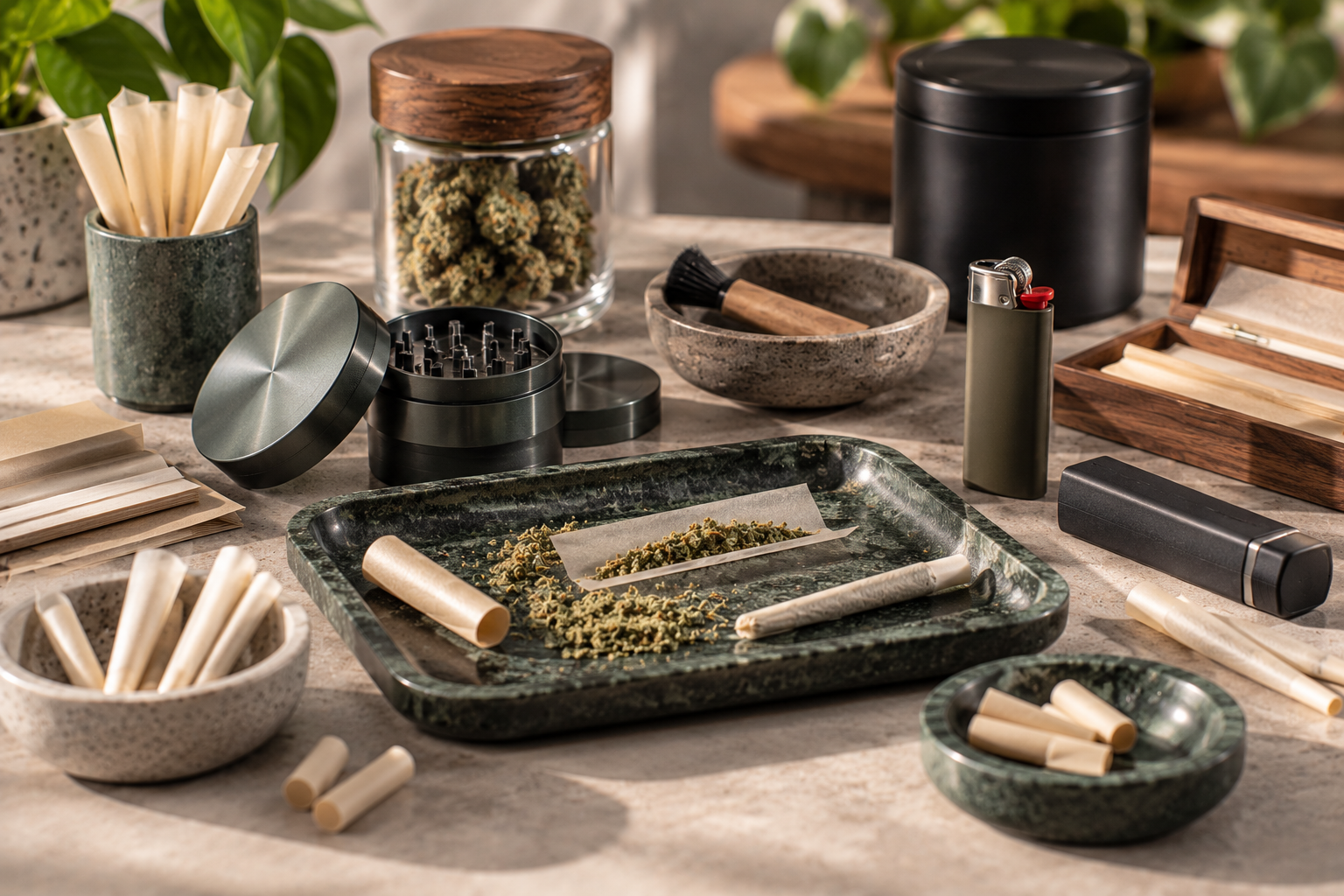
A four-piece grinder with a kief catcher can quietly collect an extra gram or more of pure trichomes over the course of a few weeks, material that would otherwise just get lost to sticky fingers and stray crumbs. That’s the kind of detail nobody tells you when you’re standing in front of a dispensary accessories wall for the first time, staring at a dozen grinders, three shelves of rolling papers, and a handful of storage jars, unsure what actually matters and what’s just packaging.
A solid cannabis accessories guide isn’t about buying everything on the shelf. It’s about understanding what each tool actually does mechanically, so you can build a setup that fits how you actually consume rather than guessing based on price or packaging design.
Whether you’re assembling your first kit or replacing worn-out tools, knowing the function behind each accessory makes shopping much faster.
What Accessories Do You Need to Smoke Cannabis?
At the most basic level, consuming flower requires only two things: a way to break the flower down into a usable consistency, and a way to combust or vaporize it. Everything else in a cannabis accessories guide builds outward from that simple foundation. A grinder handles the first job. Rolling papers, a pipe, or a bong handle the second. Storage accessories protect whatever you’re not using right away.
Beyond that core setup, most consumers eventually add a few supporting tools: a container or two for freshness, a lighter or torch depending on the method, and cleaning supplies to keep glass or metal pieces functioning properly over time. None of these are strictly required to get started, but each one solves a specific, practical problem that shows up after a few sessions.
Choosing the Best Cannabis Grinder for Your Setup
A grinder breaks flower down into smaller, more uniform pieces than tearing it apart by hand ever can. That uniformity matters mechanically: evenly sized pieces burn more consistently and allow better airflow through a joint, pipe, or bowl, which is the main reason most regular consumers use one instead of breaking buds apart with their fingers.
Two-Piece vs Three-Piece vs Four-Piece Grinders
The simplest grinders are two-piece designs, just a lid with teeth and a bottom chamber, twisted together to break down flower. They’re inexpensive and easy to use, though you’ll need to scoop ground material out manually.
Three-piece grinders add a middle chamber with holes that let ground flower fall through into a separate storage compartment, keeping it away from the teeth and making it easier to access without digging around.
Four-piece grinders add one more layer: a fine mesh screen between the middle chamber and a bottom compartment. That screen is fine enough to let kief, the powdery trichomes that separate from flower during grinding, sift through and collect separately from the rest of the ground material.
What Is a Kief Catcher?
A kief catcher is that bottom chamber in a four- or five-piece grinder, and it exists specifically to collect kief as a byproduct of the grinding process itself. Kief accumulates gradually with each use, and it’s chemically more concentrated than flower because it consists almost entirely of trichome material rather than plant fiber.
You can sprinkle collected kief onto packed flower, press it into hash, or save it separately for later use. Choosing a grinder with a kief catcher is one of the more practical upgrades in this entire cannabis accessories guide, since it turns grinding, something you’re doing anyway, into a way of gradually building up a separate, concentrated byproduct at no extra cost.
Types of Rolling Papers Explained
Rolling papers look interchangeable at a glance, but the material they’re made from meaningfully changes how a joint burns and tastes. Understanding these differences is one of the more useful parts of any cannabis accessories guide for someone who rolls their own.
Rice, Hemp, and Flax: How Paper Material Affects Burn
Rice papers are thin and burn slowly, with very little inherent flavor, which lets the natural terpene profile of the flower come through more clearly.
Hemp papers are slightly thicker and tend to have a mild, earthy character, along with a reputation for durability that makes them a common choice for less experienced rollers.
Flax papers are prized for being extremely thin and for producing an especially slow, even burn, though their delicacy can make them a bit harder to roll with for beginners.
Wood pulp papers, the most traditional option, are typically the thickest of the group, which makes them easier to handle but generally results in a faster burn rate and more ash than thinner alternatives.
Paper thickness plays as big a role as material. Thinner papers generally burn slower regardless of what they’re made from, since there’s simply less material for the flame to consume as it moves along the length of the joint.
Best Rolling Papers for Joints: Matching Paper to Skill Level
There isn’t one universally best option, since the right paper depends on experience level and what you’re prioritizing. Wood pulp or standard hemp papers are usually the easiest starting point for someone new to rolling, since their slightly thicker structure is more forgiving of an imperfect roll and less likely to tear during the process.
Rice and flax papers reward more practice and are generally better suited to consumers who’ve rolled enough joints to handle a more delicate material without frustration.
Pre-rolled cones are worth mentioning here too, since they sidestep the rolling skill question entirely. A cone is a pre-shaped paper tube that just needs to be packed and twisted closed at the end, which makes it a practical option for anyone who wants the format of a joint without spending time learning to roll one by hand.
Cannabis Pipe vs Bong vs Rolling Papers: Comparing Methods
Each consumption method changes how flower gets combusted and inhaled, and the accessories reflect those differences.
A pipe is the most direct method, a bowl connected to a stem that carries smoke straight to the mouthpiece with no filtration step in between. It’s compact, doesn’t require rolling skill, and is often the fastest way to consume a small amount of flower.
A bong adds a water chamber that smoke passes through before reaching the mouthpiece. Mechanically, that water does two things: it cools the temperature of the smoke before inhalation, and it traps some ash and particulate matter that would otherwise pass straight through. Bongs generally require more cleaning than pipes because of that water chamber, but the added glass and water mean a meaningfully different physical setup for the smoke to travel through before it reaches you.
Rolling papers work differently from either, since the joint itself burns continuously rather than being lit for a single inhale. That means a joint’s burn rate, largely determined by paper choice and how tightly it’s packed, directly affects how long a single joint lasts and how evenly the flower inside combusts from one end to the other.
What Is a Dab Rig? Accessories for Concentrates
A dab rig is a specialized piece of glassware built specifically for consuming concentrates rather than flower. Instead of a bowl, a rig has a nail or banger, a heat-resistant surface typically made of quartz or titanium, that gets heated directly before a small amount of concentrate is applied to it and vaporizes on contact. Like a bong, most rigs use water filtration to cool the vapor before it reaches the mouthpiece.
Dabbing accessories typically include a torch or electronic nail for heating, a dabber tool for handling small amounts of concentrate cleanly, and sometimes a carb cap, which controls airflow over the heated surface to manage how the concentrate vaporizes. This setup is more involved than flower accessories generally require, so it’s worth reading up on the products before investing in the tools.
Cannabis Storage Accessories: Keeping Your Setup Fresh
Storage accessories round out a complete cannabis accessories guide, since even the best grinder or rolling papers won’t matter much if the flower itself has degraded from poor storage.
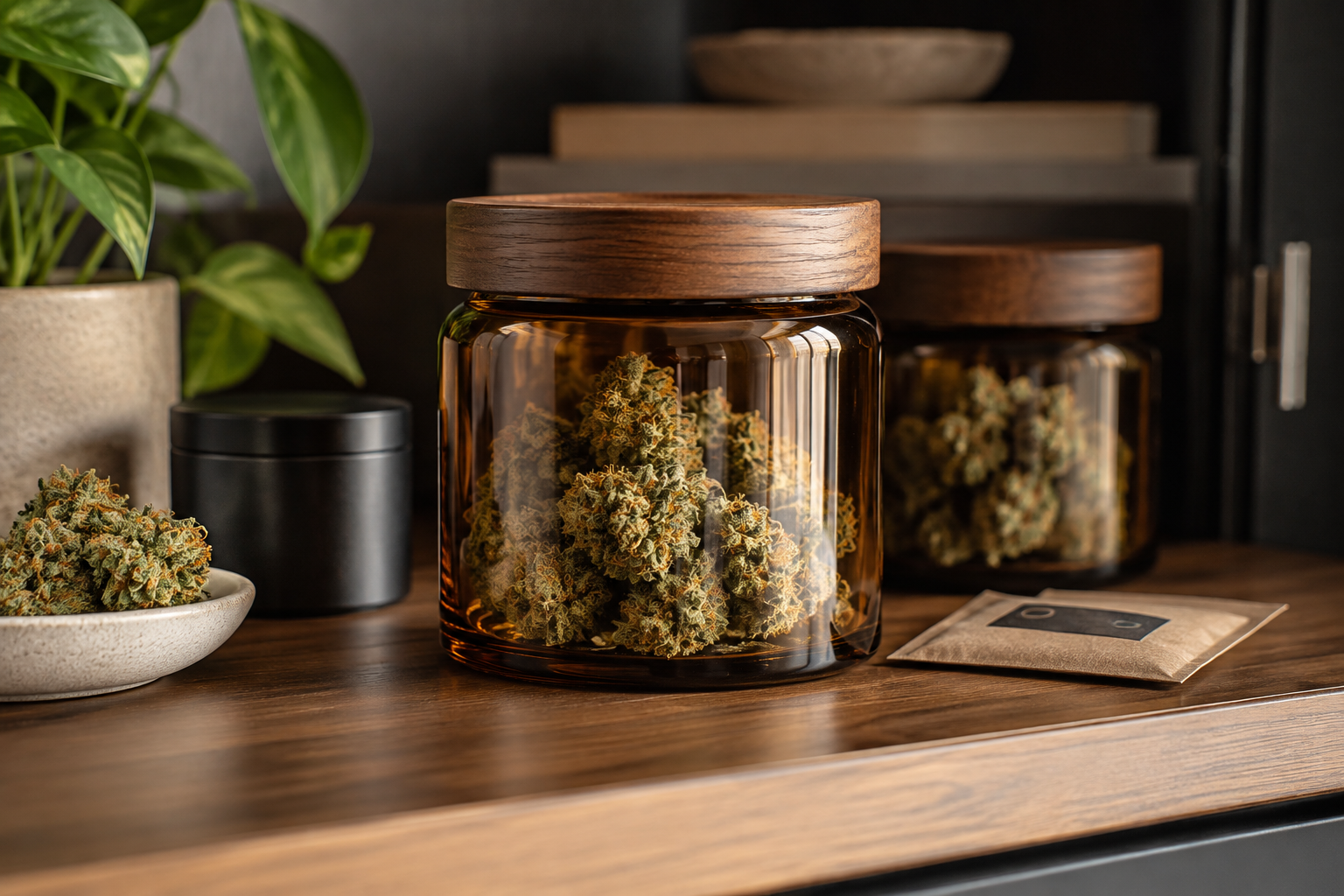
Airtight glass jars, ideally opaque or kept in a dark cabinet, protect flower from light and air exposure.
Two-way humidity control packets maintain a stable moisture level inside a sealed container, which keeps trichomes intact without inviting mold.
Building a Cannabis Starter Kit
For someone assembling a first setup, a practical starter kit covers the basics without overspending on accessories that might not match personal preferences yet. A simple three- or four-piece grinder, a pack of hemp or wood pulp rolling papers for easy rolling, an airtight glass jar for storage, and a basic pipe as a backup for sessions where rolling isn’t practical cover nearly every common scenario. From there, it’s easy to add specialized pieces, a bong, a dab rig, premium papers, as preferences become clearer with experience.
Gift buyers shopping for someone else can follow roughly the same logic. A well-made grinder and a quality storage jar are safe, broadly useful choices that work regardless of a person’s preferred consumption method, since almost everyone who uses flower needs both.
Assembling a Setup That Works for You
The right cannabis accessories aren’t about having the most elaborate collection on a shelf. They’re about matching specific tools to how you actually consume, whether that’s a quick pipe session, a carefully rolled joint, or a full dab rig setup for concentrates.
Understanding what each accessory actually does mechanically, from a kief catcher separating trichomes during grinding to water filtration cooling smoke in a bong, makes it a lot easier to build a kit that holds up over years of regular use rather than one that gets replaced piece by piece through trial and error.