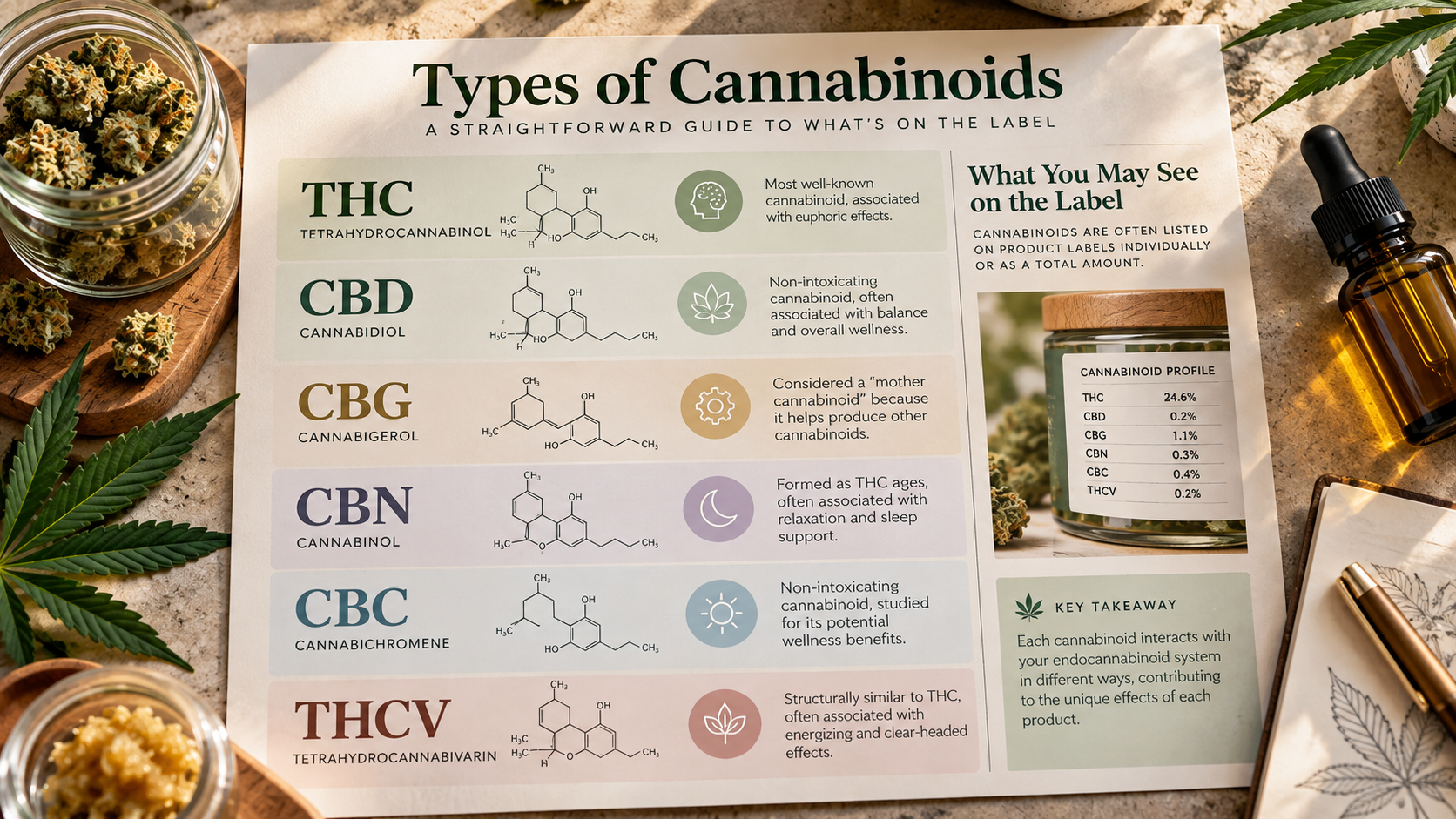
Cannabis plants have been found to contain well over 100 distinct cannabinoids, yet most dispensary labels only ever mention a handful of them. That gap is exactly why so many shoppers stall out at the cannabinoid section of a label, unsure what CBG, CBN, or THCV actually are or how they relate to the THC and CBD they already recognize. Once you understand the basic chemistry connecting these compounds, that label stops being a wall of letters and starts making sense.
Every cannabinoid starts from the same chemical starting point in the plant, which is why understanding the types of cannabinoids as a family, rather than as unrelated ingredients, helps the topic click faster. Here’s what each one is, how they relate to each other, and how to read them the next time you’re comparing products.
Where All Cannabinoids Start
Inside the trichomes of a cannabis plant, nearly every cannabinoid begins as a single precursor molecule called CBGA, or cannabigerolic acid. As the plant matures, specific enzymes convert CBGA into the acidic precursors of THC, CBD, and CBC, which is why CBGA is sometimes called the parent compound of the cannabinoid family. Whatever CBGA doesn’t get converted stays present in smaller amounts, which is where CBG itself comes from.
This shared origin helps explain why different types of cannabinoids appear in different concentrations depending on the plant’s genetics and growth stage. A young plant tends to carry more CBGA and less of the downstream compounds, while a fully matured plant has usually converted most of that CBGA into THCA, CBDA, or CBCA.
THC and CBD: The Two Cannabinoids Everyone Recognizes
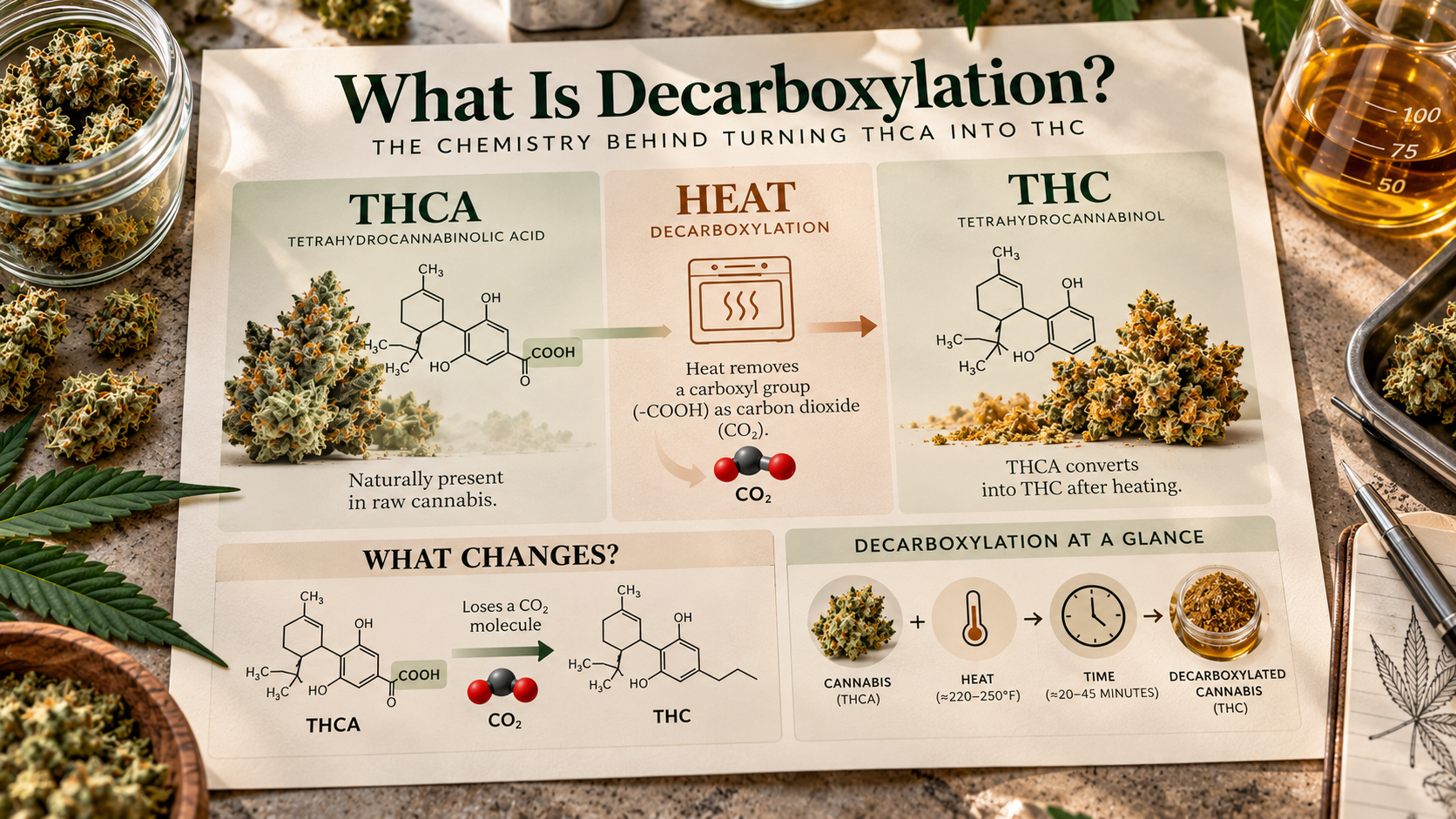
THC, or delta-9-tetrahydrocannabinol, is the cannabinoid most closely tied to regulatory THC percentage limits, adult-use purchase age requirements, and potency testing on every product label. In raw flower, THC exists mostly as THCA until heat converts it through decarboxylation, which is why lab reports list both a raw THCA number and a calculated total THC figure.
CBD, or cannabidiol, is the cannabinoid tied to the federal hemp exemption established by the 2018 Farm Bill, which permits hemp-derived products containing no more than 0.3 percent THC by dry weight. That regulatory distinction, more than anything else, is what separates a hemp-market CBD product from a THC product sold through a state-licensed adult-use dispensary. Both cannabinoids get identified and quantified the same way on a COA, through chromatography testing that reports concentration in milligrams per gram and as a percentage of total weight.
Minor Cannabinoids Showing Up on More Labels
Minor cannabinoids are simply the cannabinoids that occur in smaller concentrations than THC and CBD in most cannabis plants. They’ve always been present in the plant, but improvements in extraction and isolation technology have made it commercially practical to concentrate them into standalone products, which is why terms like CBG, CBN, and THCV show up on far more labels today than they did five years ago.
CBG vs CBD: Two Different Molecules From the Same Starting Point
CBG, or cannabigerol, is the neutral form of that CBGA precursor described earlier. Comparing CBG vs CBD comes down to their position in the plant’s biosynthesis pathway: CBG is closer to the original precursor molecule, while CBD is a downstream compound synthesized from CBDA. Chemically, they’re distinct structures with different molecular formulas, and labs test and report them separately. Product formulations that isolate CBG specifically have become their own category within cannabinoid products, distinct from standard CBD isolates or full-spectrum CBD extracts.
CBN and Aged Cannabis Chemistry
CBN, or cannabinol, forms through a different process than most other cannabinoids. Rather than being synthesized directly by the plant in significant amounts, CBN is primarily created when THC oxidizes over time, meaning cannabis that’s been stored longer, or exposed to more light and air, tends to test higher for CBN. Because of this, some brands package CBN into gummies and tinctures specifically labeled for nighttime use, often formulated alongside other ingredients like melatonin. CBN’s presence in a product is a measurable chemical fact, confirmed the same way any other cannabinoid is confirmed: through lab testing listed on the COA.
THCV: A Structural Variant of THC
THCV, or tetrahydrocannabivarin, shares much of THC’s molecular skeleton but with a shorter side chain, propyl instead of pentyl, which is a small but meaningful structural difference. That structural variation is why THCV gets tested and reported as its own distinct cannabinoid rather than grouped in with standard THC content. THCV occurs naturally in only a limited number of cultivars, which is part of why THCV products are more commonly formulated using concentrated extracts, often blended with THC in specific ratios, rather than sourced from flower alone. You’ll frequently see THCV paired with THC in daytime-branded formulations, a product category naming convention rather than a claim about the cannabinoid itself.
CBC and the Rest of the Family
CBC, or cannabichromene, is another compound synthesized from the same CBGA precursor and is structurally distinct from THC, CBD, and CBG despite sharing that common origin. Rarer cannabinoids like CBDV and CBGV show up even less frequently, typically in trace amounts within a broader cannabinoid panel rather than as standalone products, though ongoing pharmacological research continues to expand what we understand about the full range of minor cannabinoids the plant produces.
How to Read Cannabinoids on a Label
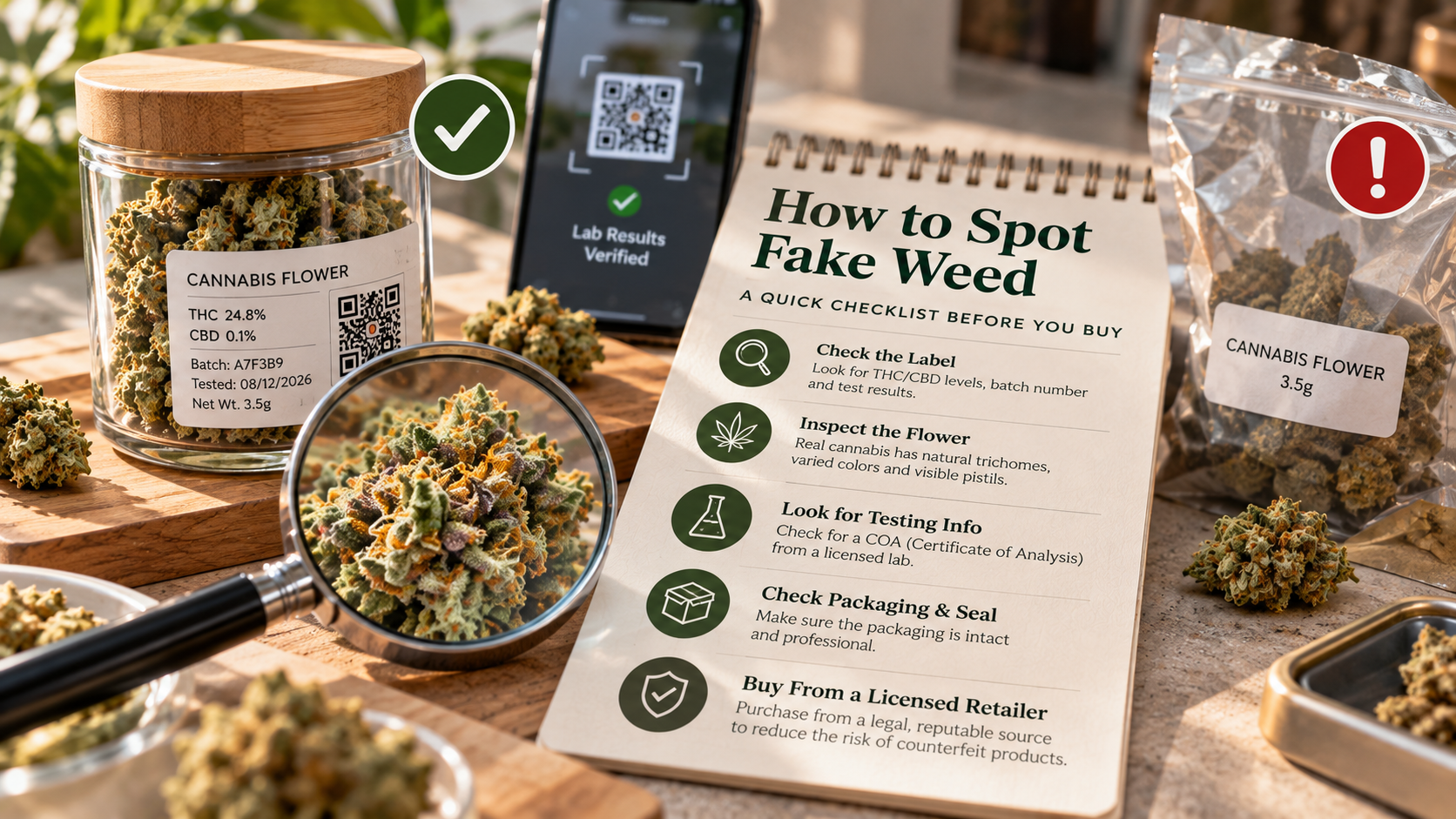
Reading the cannabinoid section of a product label comes down to a few consistent conventions across the legal market. Every cannabinoid should be listed by name alongside two figures: a concentration in milligrams, either per gram of product or per serving, and a percentage representing that cannabinoid’s share of the product’s total weight. A raw flower label typically separates THCA from THC directly, while a processed product like a vape cartridge or edible usually reports total THC as a single combined figure, since the decarboxylation step already happened during manufacturing.
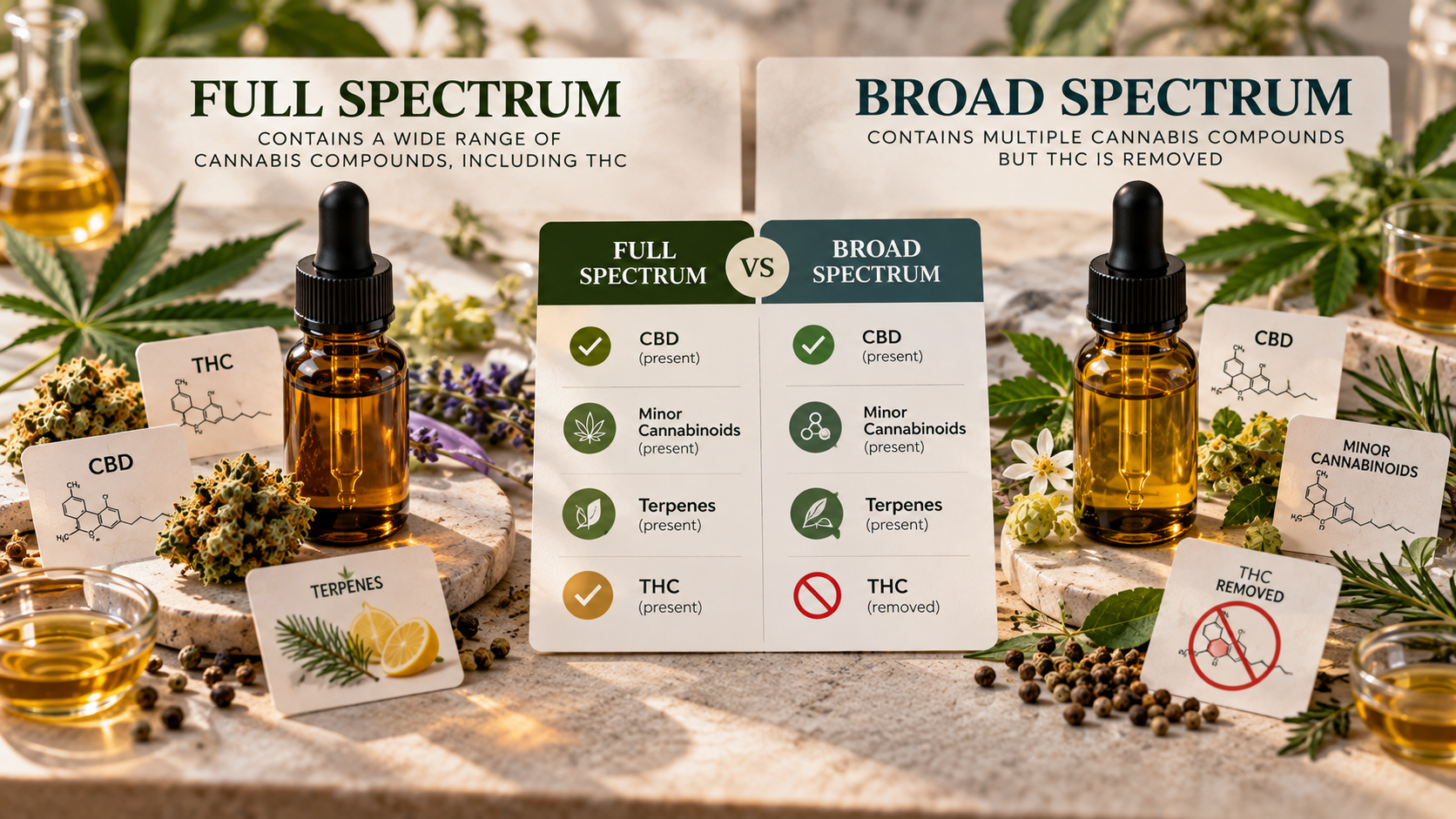
Product type also affects how cannabinoids are formulated and labeled. An isolate contains a single cannabinoid, extracted and purified with no other cannabinoids or terpenes present. A full-spectrum product retains a broader range of the plant’s naturally occurring cannabinoids and terpenes. Ratio products, meaning items formulated to a specific cannabinoid-to-cannabinoid ratio like 1:1 or 5:1, list that ratio directly on the packaging, giving a quick reference for how the product’s cannabinoid content is balanced. For a closer look at what the rest of a lab report covers beyond the cannabinoid panel, our guide to reading a cannabis COA walks through the full document section by section.
A Quick Reference Chart
| Cannabinoid | Chemical Origin | Common Product Formats |
| THC | Converted from THCA via decarboxylation | Flower, vapes, edibles, concentrates |
| CBD | Converted from CBDA | Isolates, full-spectrum extracts, tinctures |
| CBG | Neutral form of the CBGA precursor | CBG isolates, ratio products |
| CBN | Forms from THC oxidation over time | Nighttime-branded gummies and tinctures |
| CBC | Synthesized from CBGA | Full-spectrum extracts, minor cannabinoid blends |
| THCV | Structural variant of THC with a shorter side chain | THC:THCV ratio products, daytime-branded blends |
Reading a Label With the Full Picture
Once you know where each cannabinoid comes from chemically and how it’s measured, a dispensary shelf full of unfamiliar abbreviations becomes a set of specific, comparable data points instead of a guessing game. If you’re still new to cannabis, be sure to connect with our staff to discuss your goals, tolerance, and the product formats that may fit your needs. They can also help you compare cannabinoid ratios, serving sizes, and lab results before you make a selection.